Showing posts with label Birds. Show all posts

Wednesday, June 29, 2016

Bird Bling on the Beach

The Piping Plover is a not very big bird.  Smaller than a Cardinal and with colors the same shade as the sands they nest on, it would be easy for your average person to overlook them.  

Of course, any good birder knows you can find birds in their appropriate habitat.  In the case of the Piping Plover, just looking for the signs is a great place to start...


A few days back, Natalie and I split town. During our two-day road-trip, we had the opportunity to be official National Park Service volunteers.  Seriously. Official.   All we needed to do was to fill out official papers and "Voila", we're in!  We had it all.  Our own car, guns, badges and small helicopter were all at our disposal. We even had our own guide.

It helps when you wife's uncle is a Service employee.  Dan has been at Sleeping Bear Dunes National Lakeshore for a few years now.  While a large part of his job is coordinating the investigations of miles of beach to collect dead birds for botulism studies, he can break away and tackle other projects. With him as our official team leader (in large part because Natalie and I had no idea what the hell we were doing), off we went.


In the event you have just been released from a Turkish prison, the Piping Plover is a critically endangered bird. This listing is not just for Michigan, but at the Federal level, as well.   Rough figures put this little bird at only between 50 and 60 nesting pairs in the entire Great Lakes area and less than 7,000 individuals worldwide. To the best of my knowledge, that number exceeds the number of Americans who think Dan Quayle would have been a good President in 2016, but I digress.....

With a need to monitor not just nests, but the individuals in various territories, banding is key.  Take this bird for example...

The official Fish and Wildlife Service band on the upper left leg does not help you identify the bird at a distance. In the hand, you have read the number, but so what, right?  All the birds look the same from 30 feet away. However, the combination of the reds and greens and their specific placement lets researchers identify individuals.  Green-over-red would not be the same bird as red-over-green.  Given the need to track these things, all birds are banded.  A non-banded bird on the Lake Michigan shoreline is a big deal.......

...which brings us to the highlight of our Plover foray.

An unbanded bird had been discovered.  Good old fashioned sleuthing on the part of the Park Service allowed researchers to find the nest in a most unexpected location.  Dan was able to show us this new spot with our official task being simply to determine whether or not the parents were still incubating. He swore us to secrecy as few people are aware of it.  But I don't care, I'll tell you.

It was under a cage.  No really.  In fact, they all nest under cages.  Well, lets back that up. The cage is added over the nest by staff after the nest has been located. It helps protect the incubating parents and youngsters from pesky predators like a Merlin.  As you might expect, the mesh on the cage is large enough for the plovers to come and go, but too small for most predators.

To further emphasize the secrecy of this location, Natalie and I had to visit the dentist.  A molar was removed only to be replaced with a fake tooth. Hidden in the tooth? A cyanide capsule.  We were instructed to flip open the fake dentistry with our tongue, extract the pill,  and bite down if we were taken hostage. The Park Service does not mess around. 

Fortunately, the weather cooperated.  The breezes from the lake were quite possibly life-saving.  The region would have been an oven.  Dunes and beaches act like concrete when it comes to heat.  Boy, that would have been rough. 

While the Plover hunt....er, bad word....expedition was certainly fun, that was not the only part of weekend.  The sunset at Empire Beach was nice, but we dipped on the Green Flash.

The hike to Pyramid Point was breathtaking. That is North Manitou Island in the upper right corner.  We are hundreds of feet above Lake Michigan.  


In the event you are wondering, the presence of the sign cautioning patrons about the steep dunes and the two hours needed to return the bluff's top doesn't stop everybody.  Per Dan, there are more emergency rescues at Sleeping Bear than there are in the Grand Canyon.  People just don't take the place as seriously as they should.  


In any case, we knew enough to not run down the dunes (unlike the local WDIV reporter). It is just such a bad idea. Instead we opted to try our hand at canoeing the Crystal River. 

I can tell you it was amazing. The speed.  The rocks.  The whitewater.  The bodies and smashed canoes everywhere were intimidating but we knew we could handle it. Only our skills saved us from certain death.  


So, while we were gone for only two days, it really does seem like we stuffed a lot in there. It's amazing what a quick getaway can do for you.  

All positives aside, I have to plant my dig. Boone Docks in Glen Arbor. Nat and I had lunch there.  While the patio was nice., three beers, buffalo wings, and mushroom caps should not cost  1.9 million dollars.  Not worth it.  

We went back and showed our bill to the plovers.  Does he looked a little puzzled about those prices?

  
Yeah, we were, too. At least he has cool jewelry he could pawn to help pay the tab. 

Saturday, June 4, 2016

The Box by the Bay

With apologies to Theodor Seuss Geisel

Walks in the spring, we look for birds,
Natalie and I, some say we're nerds. 
With boots on feet, and bins in the hand, 
Feathered things we seek, across the land.

A warm pleasant day, not so long ago,
In Ohio we were, were swamp trees grow.
A lodge, a beach, the park - Maumee Bay,
Bird here we did, at the end of the day.

On boardwalks of wood, slowly we paced,
This path through the trees, the past we traced.
We can say this, its sad, its even true
Birds on this walk, numerically few.

It really is a wonder, one might say,
Why this place can be vacant, when just up the way....
Crane Creek and their trail, with wonder and awe,
birds dripping from trees, bugs in their maw.

The walk to ourselves, for birds we stare.
Looking and listening, with patience, with care.
Not much here, a lesser birder might scowl,
Nat broke the silence - "Holy shit! An owl!


A box on a tree, not uncommon in the wood,
They're placed as a home, for animals they're good. 
The Wood Duck, they use them, gone natural holes, 
They work well on trees, on buildings, on poles. 

But its not just the duck, others may use,
Squirrels can perch here, raccoons may snooze. 
But this owl?  Seriously?  Living in a box? 
Yeah, you bet.  For the Eastern Screech, it rocks. 

The hole is perfect size, the box is as well,
Duplicating  a natural cavity, all is swell.
On a chilly spring day, bright sun can be great,
South facing hole, sun on his pate. 

I suspect one might say "Paul, your an ass...
....give the bird some space, have some class.
He's delicate and vulnerable, if he flushes, he's dead...
If he dies, your day is long, filled with dread..."

I say, the box - look, don't blame me.
Within feet of the boardwalk, it sits in the tree.
Reach it I can't, at arms length it is not, 
But, boy, is it close, what a chance I've got.

With my giant lens, the bird sitting there,
We did not speak, we used every care.
We soon moved on, further down the way,
The owl? It never moved, in the box to stay.


Not long after, let the record show,
The lodge was packed, birders on the go,
The Biggest Week in Birding, hundreds on site, 
The owl in the box, be found, he might?

Sure enough, I discover, found he was,
Seen by the masses, the conversation, the buzz.
The little red owl, in his box by the bay,
Bringing joy to many, on a chilly May day.


Friday, May 27, 2016

His Vireo-wn Show

Birding along the shores of Northwest Ohio (just east of Toledo) can be some of the most rewarding birding in North America during the second week of May.  As gillions of birds move from their wintering grounds in the south to their breeding grounds in the north, they get stopped along the Great Lakes shore line.  Any woodlot has the potential for tremendous birding if the conditions are right as the birds take a break before crossing Lake Erie. 

A few days back, Natalie and I made a day of it as we often try to do.  One day at least, per spring, is in Ohio.   

The birding was everything birders would want.  Birds were everywhere.  It was not unusual to have multiple species in one tree or multiples of one species in the same tree.  Some were high. Some were low.  Attentions need to be everywhere.

Along the boardwalk at Crane Creek/Magee Marsh, one particular bird caught our attention.


Between Natalie and I, we have about 40 years of birding experience in over 45 states and four countries.  It was with zero hesitation that we called the correct identification on our little friend - Blue-headed Vireo (VEER-ee-oh). After all, it was only feet away.

The field marks are cake.  His head (or maybe her head?... sexes look the same) has a blue-gray cast.  It contrasts nicely with the peculiar green back, wings and flanks.  Those in turn contrast nicely with the white throat, breast, and upper belly.  The white rings around the eyes are so pronounced they are called "spectacles" in the field guides as a small white bar connects them over the base of the beak.  You can imagine Ben Franklin wearing such things, can't you?

It might be worth noting that when I first started birding in the early 1990's, this bird did not exist.  Well, it did....but it didn't....

At the time, ornithologists recognized the Solitary Vireo.  However, there were stark differences in the vireo if one looked at them across the continent.  Those along the west coast looked slightly different than those in the Rocky Mountains and even more different yet compared to those in the eastern United States/Canada.  

By 1997, the molecular data showed that this "single bird" was diverse enough to warrant a split. With the bang of the gavel from the American Ornithological Union, one species became three.  Cassin's Vireo, Plumbeous Vireo, and Blue-headed Vireo suddenly existed.  (It is worth noting that this is all science mumbo-jumbo. The birds certainly don't care.)

For the record, I have seen all three vireos. My Cassin's Vireo episode can be found here.

So, as Natalie and I watched our little guy at point-blank range, we really started to appreciate it.  Normally, this bird is much further or higher and a solid look is not always easy.  Thinking back, I can say this vireo provided what is very likely the best looks I have ever had at this species. Ever. Even his subtle chirps and clicks were audible. 

Even better, he was very predictable.  As  he moved along the boardwalk, he stayed low and progressed inches at a time.  Playing off of his behavior, I advanced down the boardwalk just a few feet ahead of him and waited.  I even had the branch in mind that I hoped he would land on based on his behavior. He was so cooperative.
 
But not just for us. 

As we casually walked the boardwalk with him, another birder approached us and asked what we were pondering.  (It is worth mentioning that this happens a lot in Ohio.  You don't have to look for birds - clots of birders can usually be an indication of a something noteworthy.)

"It's a Blue-headed Vireo. He's right there....." was our response.

"Oh yeah, the Blue-headed Vireo show. He's been here all day...."

So there you have it.  

A Blue-headed Vireo. All day in the same spot?

He was putting on his Vireo-wn show. 

All by himself.


Saturday, January 9, 2016

Brambling Ramble

As a general rule, birders get excited about birds that are hopelessly lost, er... I mean out of range.

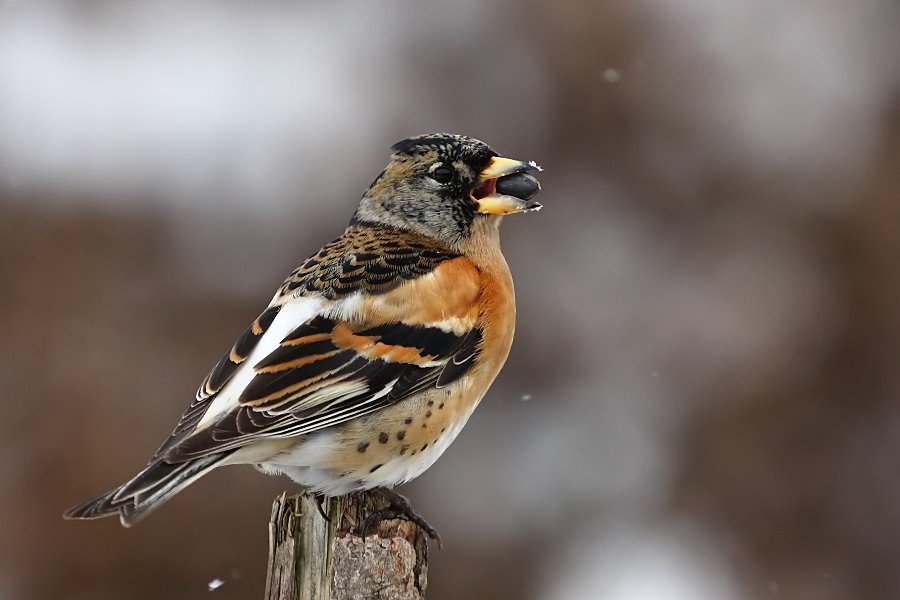
Take the Brambling, for example.  Native to Europe and Asia, this tiny finch occasionally makes its way to North America, believe it or not. Where?  You never know.  Sure, they have bred in Alaska (once) but that was considered a rare occurrence.  With records scattered all across North America, there is simply no telling where it may show up.  

So, when one was found a short hop outside of Cleveland a few days after Christmas, I was certainly watching the bird reports as I hoped to go see it.  I had never seen one before.

In the early morning hours of January 4, Natalie and I took off. 

Even though Michigan had experienced warmer than average temps for the winter thus far courtesy of "El- Meano", we found ourselves driving through lake-effect snow squalls to get to the known location. 

By 10:30 or so, Natalie and I arrived at the farmhouse outside of Medina, Ohio.  To our surprise, no one was there.  I figure most chasers had chased it. Plus, on a Monday, folks likely were at work.  With traffic concerns at zero, we conveniently parked by the house and waited.....

...about three minutes....

Natalie quickly shouted "I have it!"  I was on it moments later.


Now keep in mind,  the Canon 7D partnered with a f5.6 100-400mm internally stabilized lens with L-series glass does many great things. One, it sounds cool on a blog read by less than a dozen people.  Two, it fails to photograph a smaller-than-a-soupcan songbird at 30 yards (I would argue most cameras will on cloudy, crappy days).  So, if you grief me on the photos, well, too bad.  If you are really hankering for a nice photo, this Brambling photo is nice.  So is this one. And this one.  

Needless to say, given the precarious parking situation (a blind hill for a road with a 50mph speed limit) and the snow squalls, we opted to press on with less than 5 minutes of viewing.  This was, by the way, my 245th Ohio bird as well as my 669th life bird.   Mission accomplished.  

With the target bird in the bag, the rest of the day was ours to go play.  A quick stop at the Cuyahoga Valley National Park visitor center (yes, folks, Cleveland has a National Park) gave us a refreshed lay of the land as Natalie and I had been there before. By that point, it was basically lunch time. A quick stop at the Winking Lizard in Peninsula made for the perfect meal.  

A nearby walk noted for winter birding was not particularly exciting.  With that, we opted to pay a visit to some previously visited locations.  

Blue Hens Falls is an easy hike from the car and shows, in its simplest form, how a waterfall might form.  Water, flowing over a given substrate (in this case, sandstone), chips away at the weaker rock layers beneath (in this case,shale). 


The photograph loses scale a bit but the falls are about 15 feet tall. I would have loved to scramble down there (something I have done in the past) but I was concerned with the snow cover and my less than ideal boots.  Given the overall lack of color in this winter landscape, I thought a black-and-white photo conversion might be nice.  


A short bit later, Natalie and I found ourselves at Brandywine Falls.  While certainly beautiful, it was also once viewed as a source of energy. Remains of early mills are still present on site.  At 60 feet tall, it is considered a true gem in the region. 


After an aborted effort to secure Little Gull and Black-headed Gull at the Cleveland waterfront at sunset, we opted to move along to dinner at what has certainly become one our favorite places for chow: the Great Lakes Brewing Company.  

Started in the 1980s, its always nice to have a great beer at a place that contributed to the wave that is now the Craft Beer Movement.  Even more to the point, they take environmental issues seriously.  The tomatoes on the pizza were grown up the street. Literally.  The spent grains are passed off to farmers just outside of town. Great beer. Great food. Environmental ethic. A trifecta, if you ask me.

To make the evening even more nice, the building is older than the hills. The basement, where we ate, has old stone foundations and beams that are enough to make a historic preservationist drool. Dim but solid with a great atmosphere, this place is a must on anybody's "Where to eat in Cleveland" list.

Better yet (if that is possible), they had a band playing on the stage. Okay, the stage was basically a large step and they were two dudes with acoustic guitars, but they were really good. I'm mean really good. I'll have to postpone my own guitar phenom world tour. They were even sporting the Bob-Dylan-harmonica-on-the-neck thing.  To top all that off, the guy's name is Thor.  Way cool. What a great way to wrap up the evening.

The drive home was, as you would expect, a drag.  They always are, right? But, the day was as they should be be - great birds, fine beer, old buildings, nice scenery - all with my wife.  

What more you could you want?


Friday, September 11, 2015

August 31: Fallingwater and Drivinghome

1925 saw the opening of the Hotel Morgan in Morgantown, West Virginia. The wainscoting in the lobby would floor you. The old mailbox in the lobby with the chute that feeds in from all the above floors is the stuff of dreams. I’ve always loved that stuff.

During most of its tenure, the hotel did indeed house visitors.  At one point, apparently West Virginia University used it for student housing. I would bet vandalism and vomit suggested that was a poor idea.  It is now owned by Clarion. If you’re in the area and you dig old stuff, stay here.


Our final destination for our trip was basically placed on my “go to” list by my college advisor, Dr. Ted Ligibel.  Natalie wanted to canoe, hike, camp, watch whales, drink beer and sleep while I did all the driving. I was good for all of that, too, but this location was my “Hey, look, here is a great chance to do this. Dr. Ted said so.”

Fallingwater. (Note the lack of the space.  That’s being artsy, folks.  My spellcheck is screaming.)

Built in the late 1930’s by the intergalactically famous architect Frank Lloyd Wright for the Kaufman family (of Pittsburgh), this place will blow your mind.  Every organization or magazine claims this is a place that everyone should visit. I could not agree more. 

The amazing combination of horizontal lines with vertical lines and the fact that the home is functionally built from the bluff and is cantilevered over a waterfall is awe inspiring. Locally quarried stone and the combination of the rocks on site (some of which were not moved and are both inside and outside the home as the wall rests on the stone) provides a great melting of nature and construction. Overall, the attention detail is simply incredible.


Sadly, the home was not without its troubles. The elder Kaufman called the home, at times, Risingmildew, clearly noting the persistent dampness.  I can only imagine how the books fared. The Western Pennsylvania Conservancy, the owners of the home, brought in a team of engineers and preservationists a few years back to repair the structure.  The terraces were sagging 7 inches over a 15 foot span.  Yikes!

That said, I could never live there.  The Kaufmans were clearly not tall. At 6’0”, I was uncomfortable in some rooms as my head was barely clearing the doorframes.  Another fellow, who I would put at 6’2”, had to duck multiple times.  Wilt Chamberlin would have been screwed.  The hallways were very tight. This was Wright’s attempt to force you out onto the terraces or perhaps the large central room.  Further, the humidity was high that day.  If you are one who needs central air, you’re out of luck. That said, I’m sure the winter was pleasant with the multiple fireplaces.

In any case, get there. Take the tour. Spend a million dollars in the café (it’s not hard). Spend a billion dollars in the gift shop (it’s not hard). Support one of the most amazing places you’re ever going to visit.  Do it. 

For the non-photographers out there, the combination of the dark vegetation and the light terraces makes for awkward lighting.  If you meter off the building, the building will look fine  but the vegetation will be black. If you meter off the plants, the building will burn out and become white while they plants stay green.  Fortunately, when it came time for my photo, the clouds rolled in.  With all our frustrations involving clouds, fog and rain, this was one episode where I was happy to see the sun blocked.  The light was more even. My neutral density filters did their magic.  Silky water falls.  Ooooooooh.


If you want to buy this picture off of me, you can.  Actually, no, I’m kidding. I can’t sell it without the explicit written permission of the Western Pennsylvania Conservancy.  If they find out I sold it, they will hunt me down and throw me off the waterfall.  Or perhaps they would embed me in concrete during the next round of rehabilitation. Worse yet, they may make me live there.

Sadly, and I mean sadly, we knew we needed to press on. Fortunately, we were able to stop at our other favorite brewery, the Great LakesBrewing Company in Cleveland. Check your maps. It makes good sense.  Pittsburg to Detroit is only 4 hours. The fastest route is via Cleveland. 

We were home by 9:30pm.

Statistics:
Miles driven: 3,490
Miles per gallon: 40.2
Average speed: 43.5
Gallons used: 86.5

States visited: 8
National Park Sites visited: 7

Beer sampled: 46
Breweries sampled: 17
Beer (life total): 1,634

Birds: weeeeeell, that’s a toughy.  As the trip moved on, our birds notes became less and less. I need to still update that info but I don’t have time do it here and now.  Maybe I’ll post an addendum in the future.  No new birds for me – that’s for sure.  The Great Shearwater was new for Natalie. We missed some boreal species that would have been new for her, including Boreal Chickadee.