Monday, March 18, 2013

Silenced Timekeeper

Sadly, death comes again...

Clive Burr.   

Like the honored Raider from my previous post, the name is one most people simply don't know.  But to Iron Maiden fans around the world, the loss is heartfelt and, sadly, expected.   

Forming in 1975, various incarnations of the future heavy metal super-band bumbled through the pub scene of England.  By 1978, the line-up was getting more solid.  1979 found Clive Burr behind the set. While not as technical as other drummers of the era, Burr had skills where they needed to be including rock-solid time keeping and the ability to lay down drum grooves that parallel guitar work. He even dabbled a bit with song-writing.  

With a now intact band coupled with outstanding song-writing, EPs and albums followed.   Bigger album sales and bigger tours soon followed.  


But all was not bliss.  By the time the Beast On the Road Tour had finished in 1982, Clive knew his time with Maiden was finished.  The writing was on the wall.  The band dismissed him as a result of tour problems and personal issues (centered around the loss of his father).  

Like so many other musicians, he simply found work in other bands once his personal issues had settled. With his resume showing three Iron Maiden albums, offers were plenty.  As the years ticked by, he was in at least six other bands.  While the bands never saw stardom, one can be sure the timekeeper was solid.  They should be. They need to be.  

In the beginning, the tingling in his fingers probably didn't bother him. That is just how the human body can be sometimes, right?  But, to a drummer, training his (or her) entire body to be the instrument, tingles are not welcome when they are so severe the sticks can no longer be held properly.  A medical visit explained it all....


An auto-immune disease, the sheath around a nerve fiber is destroyed by lesions.  With this protective layer gone, electrical signals that should travel down the nerve are, in a sense, short-circuited.  Over time, symptoms get more involved. Tingles become numbness.  Numbness might lead to weakness.  Cognitive function might lessen while speech becomes slurred and balance is lost.  Coordination is gone.  Many end up in wheelchairs - too weak to walk or too uncoordinated to manage.

A drummer who can't coordinate feet and hands into a solid beat? A drummer who can't hold a stick?  Pure hell, I would imagine.  

Despite his dismissal from Iron Maiden decades previous, tensions between Burr and the band had long since passed (if indeed, there were ever any at all). With medical bills mounting from treatments, the band launched a series of fundraising concerts.  Appropriately enough, the shows, entitled "Clive Aid",  (a play-on-words with "Live Aid"), brought in piles of money. He kept his house.  Computers and special furniture made his days less torturous. 


Sadly, with no cure for Multiple Sclerosis on the horizon, Clive Burr died a few days ago.

Speaking as a drumming hack who still can't do a double-stroke roll, the drumming legacy of Burr is impressive.  

When one suggests early "Iron Maiden" and "drumming" in the same sentence, thoughts invariable drift to "Run to the Hills" as the defining song. The thundering drum beat in the beginning works for some, I suppose.  

I say no.

From a percussion standpoint, Genghis Khan stands alone.  An instrumental, this song simply would not be the same with any other drummer.

That said, "Hallowed Be Thy Name" is the better song by far.  Lyrically.  Musically.  Completely.  There is no doubt that this is the Iron Maiden masterpiece of the Clive Burr era.  

His death is tragic.  It goes beyond the loss of a premier musician. It is also tragic in the sense that a man who had complete control over his entire body (as dictated by the needs of drumming) died unable to walk or even feed himself. Frustratingly, despite millions of dollars in research, a cure eludes us. 

Clive Burr. Dead at the age of 56.
 

Saturday, March 2, 2013

There Are Now Only Four

Thomas Griffin died Thursday.  He was 96 years old.  A native of Green Bay, Wisconsin, he eventually settled down in the Cincinnati area.  He was an accountant and a father of two sons. His wife preceded him in death. 

If you never heard of him, don't feel bad. I did not know him by name, either.  But I knew of him, and I wish I had met him. 

He was a Doolittle Raider.

There are now only four.  


December 8, 1941 saw America waking up in a new era. It was much like "my" September 12, 2001. The United States had been attacked.  The attack was by surprise. It was unprovoked.

Instead, however, of passenger airplanes striking buildings full of civilians, warplanes from Imperial Japan decimated the US naval fleet at Pearl Harbor on a peaceful Sunday morning.  For the following months, loss after loss was all America knew.  The war in the Pacific was not going well.  

As anyone who understands anything can probably tell you, morale is important.  When it suffers, losses sting worse, performances are compromised,  and soldiers quit emotionally. If that happens, they're done. When they're done emotionally, so are fighting forces as a whole and eventually, the countries they fight for.

In desperate need of a morale boost, 1942 saw plans getting underway for one the most daring assaults in the history of warfare.  

The B-25 Mitchell is a medium-sized twin engine bomber.  With a crew of six, upwards of 3,000 pounds of ordinance could be dropped.  Fuel capacity, depending on the needs of the mission, could easily exceed 1,000 miles and reach almost 2,000.  It was only 52 feet long and 67 feet wide....

That makes it just small enough to launch from an aircraft carrier but big enough to bust your chops....


After just a few tests under a massive cloak of secrecy, 16 B-25 bombers were loaded onto the flight deck of the USS Hornet.  Her escort, the USS Enterprise, joined her with a small escort fleet of destroyers and cruisers (all the battleships were in ruins in Pearl Harbor). By mid-April, the task force was en route to Tokyo.  80 men, all volunteers, including their leader, Jimmy Doolittle, set out for history.  The Doolittle Mission was underway.

The plan called for the fleet to advance to within 500 miles of Japan.  This, unto itself, was a huge risk, as the two carriers were half of the operational carriers in the Pacific Ocean. If the fleet was detected and attacked, and the carriers damaged or lost, the already dire situation in the Pacific would have been infinitely worse. 

When in position, the planes would launch, gather in formation and attack Tokyo itself.  After the bombing run, they would press onto China for a safe landing at an airfield held by Chinese allies.  The fleet, after the final launch, would simply about-face and hustle back to the friendly waters of the eastern Pacific.

April 18th, 1942, was the attack date. Still almost 200 miles from the launch site, a Japanese picket-boat detected the fleet. Radio transmissions from the boat were detected telling the American fleet that the cover was blown. Mainland Japan now knew of the approaching fleet.  (Notes after the war show that the picket boat had indeed sent a message to the mainland. However, the Japanese armed forces had a difficult time believing that the American fleet was in their front yard and had responded with a request for a confirmation. No confirmation was sent as the USS Nashville used the small fishing trawler for target practice.) 

In spite of the now tremendous distances that would need to be covered, Doolittle made the decision to launch anyway - into a headwind.  Instead of "forming up" into a group of 16, each plane was instructed to head to Japan as soon as they cleared the flight deck.  Expecting the lead plane to wait for the final plan would have consumed one hour of fuel (given the four minutes needed to prep the next plane for launch). That precious fuel would be needed to cover the extra 200 miles.  

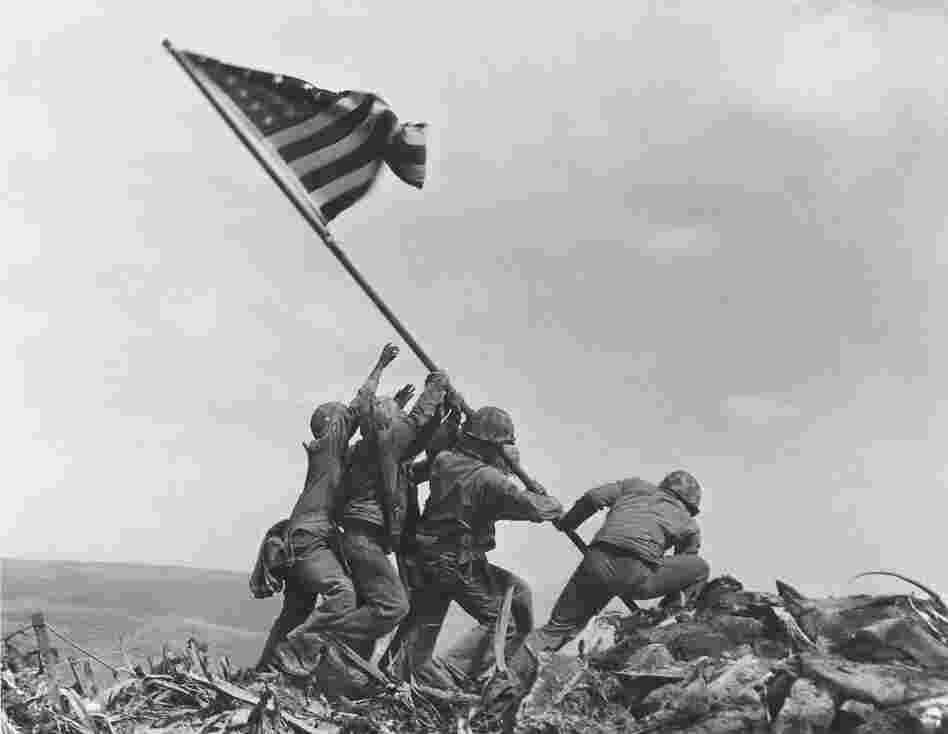
The photo below is the launch of one of the planes on the morning of April 18, 1942.  To novice military buffs like myself, I can tell you this photo has been reproduced in many books.  I would argue it is one of the most well-known images to emerge from World War II's Pacific Theatre.  (Others include this one, this one, and this one.)


Thomas Griffin, navigator of the Whirling Dervish, likely used his "pre-accounting math skills" to get his plane on target.  They were the ninth plane to launch. 

In small groups of two, three or four, the planes attacked Tokyo (and some other large cities).  In one sense, the damage to Japan was basically insignificant.  An oil field here.  A power plant there.  All damage was easily repaired.  

In another sense, the damage was huge.  Japan was attacked. Their Emperor, Hirohito, still believed to be immortal by his people, had promised them that their homeland could not be attacked.  16 bombers dumping tons of ordinance on Tokyo at lunchtime proved him a liar.

While Japan's morale took a hit, the morale of the United States shot off the charts.  It could be done - Japan can be attacked. It was attacked. 

Mission accomplished.  

Following the successful bombing run, most of the bombers set a course for China.  One bomber went more north for Russia.   In a fickle turn of fate, the winds shifted, providing a tailwind as the planes made adjustments to maximize every drop of fuel.  Every drop of fuel saved bettered the chances of the planes getting to the airfield.

By nightfall, the bomber bound for Russia had landed.  Russia, an "ally" of the United States, had signed a peace agreement with Japan before the war.  A US bomber landing on their soil unannounced was not welcome. The crew were prisoners until they escaped in 1943.

As darkness settled in and the rain commenced, the other 15 planes crashed one by one.  Each pilot made the best decision they could.  Some ditched along the China coast.  Others bailed out over the jungles.  Not one made it to an airfield.  

Of the 80 Raiders who launched that morning,  three were killed that night during the "landings".  Eight were captured by the Japanese (who were occupying parts of China and unleashing a war against civilians, that in some regards, made the Nazis of Germany look tame).  Of the eight, four survived the war as POWs while three were executed. One died of malnutrition.  

All the others were spirited away by friendly Chinese.  They eventually made it back to thier air groups were they resumed combat missions.  Ten were killed in action in various theatres by the war's end.  Four were shot down but survived as German POWs.  Thomas Griffin was one of them.  

All Raiders received the Distinguished Flying Cross. Those injured or captured also received Purple Hearts.  The third highest military honor, the Silver Star, was given to two men, one of whom was a doctor who had to perform a field leg amputation on an injured Raider.  Jimmy Doolittle, the mission's planner and leader, received the Congressional Medal of Honor

In remembrance of their courage and sacrifice, 80 silver goblets were secured.  (As I understand the story, this was done by the citizens of Tucson, Arizona.)  Each bares the name of a Raider.  Upon the death of the individual, his goblet is turned upside down. However, he will never be forgotten, as the name is engraved twice.  The name is printed both "rightside-up" as well as "upside down". As such, in life or death, their names are forever readable.  

Upon the passing of the third remaining Raider, the two survivors will meet.  A bottle of 1896 scotch awaits them. They will have a toast to the 78 Raiders who preceded them.  Visitors can see the goblets at Wright-Patterson Air Force Museum in Dayton, Ohio.


The story of the Doolittle Raiders is awe-inspiring.  A pummeled nation.  80 volunteers.  16 planes.  Bravery.  Toughness.  Honor.  A bottle of scotch.  It is enough to make a grown man cry just thinking about it.   

On behalf of a grateful nation, thank you, Major Thomas Griffin.

There are now only four.

Sunday, February 24, 2013

Crossbills in T-town

Sunday.  No work.  No desire to stay home.  No desire to do projects that need attention.  

Sounds like a great day to go birding!

Over the last few months, Natalie and I have developed a little "route", if you will.  From my place, we head to Elizabeth Park, up through Trenton over to Grosse Ile and then down to either Lake Erie Metropark or the Pointe Mouillee State Game area.  It works well and takes most of the day.  With stops that include Westcroft Gardens, its good 'ole bird fun!

Cool birds?  Well, the immature Red-shouldered Hawk  on Grosse Ile on Hickory Island was nice. Jim the Mockingbird was at the Pine Fresh Car Wash.  Again. The Hooded Merganser feeding at the corn pile with the Mallards at Elizabeth Park  was certainly unexpected. 

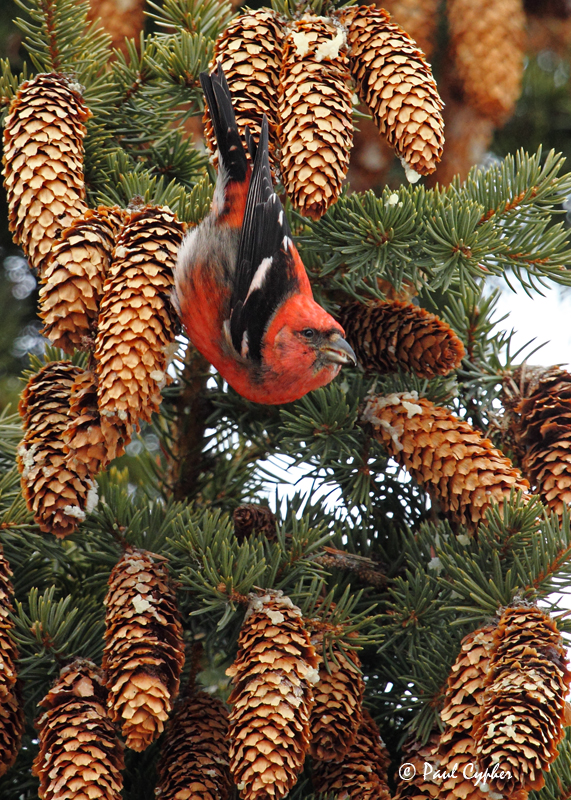
But, without a doubt, the coolest bird of the day...wait, the coolest birds of the day... had to be the White-winged Crossbills


Bloomdale Cemetery.  I've mentioned it before. One of these days, we are going to find a Saw-whet Owl in there.  Well, not today, but the Crossbills were a nice consolation prize!

Natalie and I had split up to cover the cemetery in a more timely manner. I was near the front of the place while she stayed towards the back.  After a few minutes, over the din of traffic, I realized she was yelling for me.  Within a few moments, I had done a sprint across the property.  (I figure 95 yards in 3.54 seconds carrying a 74-pound camera.  Suck on that, Denard Robinson.)  I was just in time to see 20 White-winged Crossbills fly away. Isn't that how it always works?

As they flew west, we figured, briefly, they were long gone. Ahhhh, but a few hundred yards up the road?...more conifers.  

Leaving the cemetery, we shot up King Road and pulled over into a service drive and spent a good 15 minutes enjoying the show at point-blank range.  We were so close, and they we so loud, we could easily hear the crunching of the seeds as they plied them open with that goofy crossed bill.  How awesome.

Frustratingly, the cones were all high in the tree so they were never any lower than 10 feet or so. But, we managed.  The above photo was taken from the service drive.

So, this is getting pretty peculiar.  A swarm of White-winged Crossbills in February. In Trenton.  On New Years Day, we had a Snow Goose flying over Fort Street.   In Trenton.  That is two super birds in two months. In Trenton.

Hmmm...I wonder what T-Town will bring us in March?

Monday, February 18, 2013

Birds And Brews, Eh?

This past week found me on the road.  Now and then, when I can, I sneak away for professional conferences and workshops.  This was no exception.  My supervisor, Kevin,  and I shot off to Perth, Ontario for a week.

Sure, I could tell you that I visited the Canadian Museum of Nature and that it was so cool you need to visit it, too.   Yes, I could tell you that I also visited the Canadian Museum of Civilization.  It was every bit as cool, if not more, than the Nature Museum!  I could tell you that Perth, Ontario, the location of the workshop, is every bit as quaint as it was when I was there 4 years ago.  

All that said, lets put work-related stuff aside.   Sure, I paid my own way and learned some things during the week, but lets address the real issues of this blog - birds and brews.

Beer first.  Beyond any doubt,  the best beer of the trip pairs with one of the coolest names for a beer I've seen in a long time.  Flying Monkeys Craft Brewer's Smashbomb Atomic IPA ( #1,405) is a must.  Period.  While their website is a clunky failure, their beer is not.  At 70 IBUs, this brew is made with 4 malts and 8 different hops.  Outstanding!  Get a bottle of this when you can and let those little, winged primates carry you off to beer bliss.  What a treat!


Of course, when you have a good beer, you have to have less-than-good beers, right?  If less-than-good is your game, head to the Clock Tower Brewery in Ottawa. I'm not trying to dog them too bad here, but the beer was, at best, average....or below.  Between the Clock Tower Red, Kolsch, Raspberry Wheat Ale, and the Wisarts ESB (#1,400-#1,403),  not a one jumped out as an above-average brew.  None of them.  A common theme seemed to be lackluster traits.  Nothing seemed to really power home - aromas were light, tastes were dull or lifeless. All beers left you thinking "What is going on here?"    In addition, a sampler is NOT supposed to be 8 oz glasses!  That is a not a sample. That is a half pint!  (For the record, Kevin and I were comparing notes. While he does not keep a spreadsheet, he can appreciate a good beer and knows "dull" when he tries it.  He and I are on the same channel here....)

So, while some of Ontario's brews were a bit disappointing, Ontario's  winter birding did not.  While the birds were not new for me, you cant really pass up the chance to see them. Plus, knowing they were new for Kevin, it was fun to play "tour guide", do the homework, and make sure he saw these winter gems before our trek home.

A few hours of conference "downtime" allowed Kevin and I to hustle east of Ottawa to track down some Great Gray Owls.  After heading to the known location, we found....uh, three of 'em...


Almost three feet tall, they are actually larger than Great Horned Owls, but they don't have much beef to them. While the Horned Owls are killing larger critters like skunks and rabbits, Great Grays tackle little mousies and the like.  Skunks? No way.  

They also have the habit of being pretty "tame".  Using a 400mm lens (which actually functions like a 560mm lens on my camera), staying low, and speaking with Kevin in hushed tones, I was able to secure a few nice photos.  


With the conference officially ending on Thursday night, most people left for home at dawn on Friday.  I totally understand.  A 500-mile drive can intimidate some. Not me.  With a comfy car, good company and good music, 500 miles is nothing.  Besides, Kevin and I had some stops to make. What was the point of rushing home?

Friday morning found us checking out a known location of a Boreal Owl. I can assure you I would not have seen this bird if I did not notice the "white wash" (poop) on the branches. In my experience, poop leads to owls, more often than not.  This poop was fresh. I mean fresh.  Still drippy and wet.  If the bird had pooped 4 seconds later, I would have missed it. 


For those of you who are not familiar with tiny owls, a Boreal Owl could be passed off as a Saw-whet Owl.  It has been done!  All told, the two are pretty similar in appearance.  A few key marks are obvious when you know to pay attention to them.  The silvery speckles on the forehead? Boreals only.  Look at the beak color, too.  "Bone" on the Boreal, while the Saw-whet has a black beak. This individual was a male. Such a tiny little thing...

It should be noted that we were instructed not to post the specific location on the Internet.  The bird's finder had big concerns about reckless photographers (as evidenced by horrible behaviors at the Great Gray Owl field) and other birding hacks harassing the bird and forcing it from the roost.  This bird's location is not public knowledge.

Knowing the Boreal Owl is one of North America's most wanted owl species, and knowing I always appreciate a good tip and like to share info when appropriate, I have decided to detail the location of the bird in direct violation of the finder's wishes. If you don't like my decision, tough.

The bird was in a tree.  This tree  was growing next to another tree.  These trees, in turn, were by a road.   The road intersected other roads. We weren't far from Perth. 

There you have it. Crystal clear and totally accurate directions.  Good luck with your search! 

After a few seconds of viewing (seriously, and two quick photos), we left the Boreal Owl to his siesta.  From there, our travels took us to a power-line cut south of Ottawa.  You've seen 'em.  Electrical lines running for miles across the country side slung between giant towers.  We were told to check a specific set of poles.


As you can see, the pole on the right does not match the pole on the left.  Bingo.


Frustratingly, the poles were tall. I mean tall.  Miles tall, as far as I cam concerned.  The above shot was the best I could manage with my lens.  

So, with two outstanding birds in the bag, a course was set for Oswego, New York. Tucked conveniently on the southeast shore of Lake Ontario, the harbor was the next stop.  With the car thermometer reading a balmy 44 degrees, Kevin and I started scanning the waters.  

Why?


The bird on the left is sporting a ponytail. That makes it a Tufted Duck.  In short, the Tufted Duck breeds throughout the Old World - Britain east through Siberia.  Every year, a few (really...just a few) make their way to the New World. After crossing the vast oceans, they usually just plunk themselves down near the coasts somewhere. California. Alaska.  Maryland.  This individual, a female apparently, made it as far as eastern Lake Ontario.

It should be noted that the bird was especially cool as it was a my life bird!  #663, in fact.  It was a life bird for Kevin, as well (as were the Great Grays, the Boreal, and the Hawk-Owl).  That said, we had to work for it.  While we were onsite for over an hour, total viewing time was less than 5 minutes.  Despite the small-ish size of the harbor, it managed to disappear for minutes at a time. Very frustrating.  Plus, with hundreds of Redheads, Scaup, and a small mix of Gadwall, White-winged Scoter, Long-tailed Duck, Bufflehead, and Common Goldeneye, it was not like it was the only bird there!

I should also mention the air temperature was 44 degrees. The wind-chill was easily -148 degrees. Maybe even a million degrees below zero. I dunno.  It was bone-chilling and brutal.  Somehow, my right glove had been misplaced.  Yes, the above photo sucks, but that is because the lighting was poor and I could not turn any dials on the camera.  My exposed fingers, frost-bitten in minutes, turned black and auto-amputated. I was left with stumps. Tiny dials and teensy buttons are not easy to manipulate when you have no fingers. (On the way home, my fingers grew back. Amazing....)


So, a little business combined with a little pleasure, made for a super trip. My lists now stand as follows:
Ontario Birds: 248 species (nothing new added on this trip)
New York Birds: 112 species (from 106)
Life List: 663 (from 662)
Total Beers: 1,405 species

It is also worth knowing that the 'ole Chevy Cruze, once again, performed well.  Heading east, with a slight tail wind, miles per gallons averaged 44!  One couple drove their Prius to the workshop. They recorded "only" 45 mpg.  With a headwind on the return leg, the average for our 1,200 mile drive was a still stellar 38 miles-per-gallon.  
 
Suck on that, Toyota!

Saturday, February 9, 2013

#1,394 - Not At All Mysterious

The Arctic Ocean is simply an amazing place. I was there, so I can tell you this from experience.  While I was not in it for long (I removed my shoe and sock and stuck my foot in the Beaufort Sea ("Bow- furt"), a specific region of the Arctic Ocean), I can say I was there. It was 2004 and I was in Barrow, Alaska. 

Spectacled Eiders, Thick-billed Murres, and Yellow-billed Loons were just some of the bird-goodies I observed on that trip. Snowy Owls, too. Oh, and Red Phalarope.  Cripe - I cant forget the Stellar's Eiders.  
 
While Polar Bears would have been exciting, we didn't see any.  Heck, any big Alaskan mammal could be cool to see. Even a whale.

Yeah, I guess I should remind you that whales are mammals, not fish.  They are warmed blooded, give live birth, have hair (only eyelashes in this case) and nurse young with milk. They breath with lungs, too.   Fish, on the other hand, breath with gills, are covered in slime and sometimes suffer from "hole-in-head" disease (alot like a Republican). 

Anyhow, one of the most mysterious whales of them all is the Narwhal. I so wanted to see one.


The Narwhal is different things to different to people.  To Native Alaskans, the Narwhal is 20 feet of food.  The flesh is rich in Vitamin C.  In "Elf", it is the kind creature that wishes Buddy well on the search for his dad.  To vacationers, seeing one would be the highlight of any trip, I would think.

In any case, one cant help but to be captivated by that tooth. It certainly reminds many of a unicorn. While the unicorn is completely fictional, that narwhal is the real deal. Maxing out at eight feet in length, the tusk is actual the left upper canine tooth that pierces the upper lip.  Every once in a while, the right tooth does the same thing!  It will have two!

As fascinating as it appears, scientists still don't completely understand its function.  Some suggest it is a secondary sexual trait like the mane on the lion.  Others aren't so sure, but they can't seem to offer up any better ideas.  Primitive cultures suggest that is has magic properties. That certainly can't be it.  Folklore and myth - bah!  Here we are in the 21st Century and its purpose remains a mystery.

I should mention I saw a Narwhal last night. Really. I did.


Brewed by Sierra Nevada Brewing Company, Narwhal Imperial Stout (#1,394) highlights six different malts and three hop varieties. The combination is a masterpiece of brewing. 

Fresh crude might be a fair way to describe this beer as it pours. Black. While other beer snobs noted a thick, lush tan head, my beer had nothing of the sort. Okay, whatever.  On the nose, solid notes of both coffee and chocolate were present. To boot, there was an underlying tone of some mystery "sweet". I can't be sure what it was, but it certainly added to the allure of the aroma.  

The first aspect of the tongue that strikes you is the thickness.  Very syrupy and very smooth. Very.  Smooth.  At this point, the chocolate and coffee notes become even stronger while the hops notes (basically undetectable in the aroma) start to move along.  By the time you swallow it, the hops have pushed to the front and you are left with a very satisfying but very subtle dryness.  

What a superb drink. Narwhal, the mammal, is apparently still a very mysterious creature.  Narwhal, the beer?  There is no mystery. Buy this beer.   Five out of five.